
1% Random Draw (2nd) San Diego 20260608
CitizensOveright (2026-06-08) RayLutz
This Page:
copswiki.org/Common/M2056
More Info: ElectionIntegrity, ElectionAudits
Venue: San Diego County Registrar of Voters
After Ten Years, San Diego County Expanded Its Election Audit. The Underlying Problem Remains.
On June 8, 2026, the San Diego County Registrar of Voters conducted a second public random draw to select additional vote-by-mail ballot batches for the county's 1% Manual Tally Audit.
That may sound like a routine administrative event. It was not.
The additional draw expanded the audit pool to include hundreds of thousands of vote-by-mail ballots that would otherwise have had no chance of being selected for audit. The decision represented a significant change in how San Diego County approaches election auditing and addressed an issue I have been raising since 2016. But it was only a partial step. Even after the second draw, about 140,000 ballots were not audited at all
The broader issue extends well beyond San Diego County and affects election auditing throughout California. California is bad, but the rest of the country is also largely performing inadequate audits.
Where the 1% Manual Tally Came From
California's 1% manual tally audit dates back to the early era of electronic vote tabulation.
Election officials and lawmakers understood that computerized tabulation could produce incorrect results if systems were misconfigured or operated improperly. Software can be subverted. To provide an independent check, counties were required to manually count ballots from a sample of precincts and compare those results with the machine count.
At the time, almost all voting occurred at polling places. "Absentee" voting by mail existed, but it represented a very small portion of the electorate. When counties began their audits, nearly all ballots had already been counted.
Under those conditions, the audit effectively covered the entire election.
Over time, voting habits changed.

California expanded absentee voting. Permanent vote-by-mail status became available in the mid 1990s. Eventually the state adopted the practice of mailing ballots to all active registered voters.
As vote-by-mail grew, the audit system remained largely rooted in procedures developed during an era when most voters cast ballots in person.
Around 2006, then-State Senator Debra Bowen sponsored legislation (SB 1235) clarifying that vote-by-mail ballots had to be included in the 1% manual tally audit. Up to that point, they were excluded completely. The change reflected the reality that a growing share of California voters were casting ballots through the mail.
Previously, the 1% manual tally law (Cal Code 15360) said that the audit would include "one percent of precincts" and it was changed by SB-1235 to "one percent of precincts and mail ballots." But the election officials did not like the change, and they decided to block it.
Discovering the Gap
About 20 years ago, I began as a side project, examining how San Diego County conducted its elections. It took me about 10 years to gather enough information to finally understand the process and also understand that audits were being performed.
Then in 2016, I finally had a good understanding and could tell that something was wrong.
The county did follow the change in the law in 2006 and included vote-by-mail ballots, but only those that had been fully processed by election day. Ballots that arrived on time but were processed later during the canvass were excluded from the population randomly selected for auditing.
It was hard to understand what was happening because election reports used different ballot counts at different stages of processing, and county officials were not eager to acknowledge that a large group of ballots was receiving no audit coverage at all. They tend not to fully openly state what they are doing, and to figure it out, you have to ask for more information. That takes time, because they are also adept at avoiding returning information unless they have to.
Just watching the random draw or the tallying of paper ballots was not enough. You had to know what the full population of ballots was and check it yourself.
In 2016, I determined that approximately 285,000 timely vote-by-mail ballots were being left outside the audit pool.
I contacted then-Registrar of Voters Michael Vu and requested that the county add approximately eight additional audit batches. Doing so would have extended audit coverage to those ballots and brought the county into compliance with what the law required.
Vu said he "respectfully declined."
The Lawsuit
At that point, I filed suit as a self-represented litigant. Later, it was extended to represent Citizens Oversight and handled by Attorney Alan Geraci, of San Marcos.
Silly me. I expected the matter could be resolved without extensive litigation. The additional auditing represented a relatively small amount of work and expense compared with the county's overall election budget. I honestly thought they would just arrange for a change of procedures in the future.
Instead, the county fought the case tooth and nail.
Ray Lutz talking to Media at initial press conference, 2016-06-17:
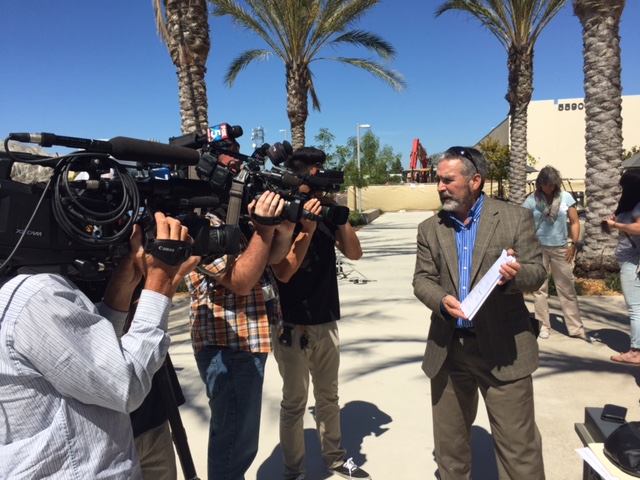
The litigation proceeded through a full court hearing. Recordings of the proceedings were not permitted. (You might ask why would a governmental office proud of its activities would not want it to be public.) After months of effort, we obtained a favorable ruling at the trial court level. (Read the ruling by the court in our favor: https://copswiki.org/w/pub/Common/M1658/Lutz_Vs._Vu_Ruling_on_Injunction_CCE07282016.pdf))
For anyone that wants to review the complete record, including court documents, press conferences, protests and other actions, please see ElectionAuditLawsuit
The Circumvention

We won. But the battle was not over. The County and Vu refused to accept the tiny change to their procedures. The county appealed.
The appeal was expected. But election officials believe they don't need to be beholden to any law they don't particularly like. They knew we had a strong case, and we would win the appeal.
Therefore, while the appeal was pending, election officials pursued a change in the law so they would not have to perform complete audits, and they would be guaranteed to get their way.
Through the California Association of Clerks and Election Officials (CACEO), language was inserted into AB 840 (see https://leginfo.legislature.ca.gov/faces/billNavClient.xhtml?bill_id=201720180AB840), a bill that originally dealt with signatures on vote-by-mail ballots.
If you look carefully at Election Code section 15360, it first says
| California Election Code section 15360 (extract) |
|---|
| 1% Manual Tally: Elections officials conduct a public manual tally of 1% of all ballots tabulated on a voting system during an election, including vote-by-mail ballots. |
But then later, it expands on this requirement:
| California Election Code section 15360 (extract) |
|---|
| ...using either of the following methods: (1) (A) A public manual tally of the ballots canvassed in the semifinal official canvass, including vote by mail ballots but not including provisional ballots |
The term "semifinal official canvass" includes only the vote by mail ballots received by election night.
| California Code, Elections Code - ELEC § 353.5 |
|---|
| The “semifinal official canvass” is the public process of collecting, processing, and tallying ballots and, for state or statewide elections, reporting results to the Secretary of State on election night. The semifinal official canvass may include some or all of the vote by mail and provisional vote totals. |
Thus, elections officials changed the law by putting forward AB-840 which redefined the audits as only applying to the election night results and pushing it through late in the legislative calendar. It changed the requirement from
- "conduct a public manual tally of the ballots tabulated by the voting system, including vote by mail ballots, cast in 1% of the precincts chosen at random, as specified"
to
- conduct "A public manual tally of the ballots canvassed in the semifinal official canvass, including vote by mail ballots but not including provisional ballots, cast in 1 percent of the precincts chosen at random by the elections official."
This was done late in the legislative calendar and without full opportunity to comment on it. The only reason I found out about this change was that I was contacted by a friendly election official. We formed as much opposition as we could in the short time provided but it was a done deal. Elections officials need something? Of course we give it to them.
Thus, they reduced the audit to cover only the semifinal official canvass, which may sound good to officials that want to economize, but it means only those ballots processed by election night are audited, ignoring all those not processed until later. Any statistical expert will tell you that this is ridiculous. Philip Stark, professor at Berkeley, (https://statistics.berkeley.edu/people/philip-b-stark) testified to that effect in the court hearings and we appreciated his kind assistance in our case. He is the "inventor" of Risk Limiting Audits (RLAs) and the question was almost a silly one for his expertise. Of course you can't omit 285,000 ballots from the random draw.
It's like the IRS saying, "We're going to audit your books at random sometime next year, but not after July." Obviously, any fraudster could cheat on their taxes in the latter part of the year without any fear of being caught.
Same here. If the computer code were modified to alter the result later in the election, then that would never be detected.
The problem is that elections offices can delay and not process mail ballots received on election day and make sure those are not included in the audit, and indeed, that is what they are doing, as they are not really trying to process ANY mail ballots on election day. But there is no legal requirement that they make even a reasonable attempt to include as much as possible. All their call.
They win, the public loses.
Once the law changed, the appellate court concluded that the dispute had become moot. Later, Vu said our case was frivolous.
The question I had raised was fully resolved in the Superior Court case. We had a full evidentiary hearing. the merits all examined. But instead of accepting that, the election officials worked to change the law to avoid the effect of our case and permit the practice to continue, even though it goes against all logic and statistical theory about auditing.
To make it all worse, the appellate court ruled that our attorney would not get fair compensation for pursuing the case and prevailing (go figure), they did at least rule that each party would cover their own costs.
Despite that ruling, the county placed a lien on my property to the tune of over $10,000 which flew under the radar because in our minds, the case was concluded. Six years later, when I attempted to sell the property in 2023, I was told that the lien existed. No big deal, I thought, we'll just resolve that with the proceeds of the sale.
Aha, not that easy. No, I could not just pay it using proceeds from the sale. Instead, I had to clear up the lien in court before we could close. We had to back out of the property purchase we had made an offer on as a result and it took months to resolve.
Okay, San Diego County. Not only do you want to conduct partial audits, but you can't stand to lose, and will dig in your heels even if it starts looking pretty stupid, and slap me up for pursuing the case, even though we were right all the while.
I have been amazed at how far they would got to cover their asses and make it appear that everything is fine. And the courts are largely complicit. Indeed, despite the win and the appellate order that we would pay costs equally, I was required to cover their costs in addition to our own. Of course, I was under the gun at that point, and I could not take my time.
Why is this all necessary to avoid conducting full and complete audits?? Why did we not conduct the hearing in public, allowing video recording? Why not admit that we won the first case even if you do want to change the law? And then why not use a full procedure to change the law, including sufficient time to comment and raise an opposition??
This level of avoidance makes my mind spin through quite a number of possible conspiracy theories, a rabbit hole we won't go down as this is getting pretty long as it is.
The Problem Grew Larger
Since 2016, California has even further embraced vote-by-mail elections.
Today, roughly 90% of ballots cast in many California counties are vote by mail (VBM) ballots, because all active registered voters are mailed a VBM ballot which they can use if they want to, or vote in person. I personally like VBM voting because it feels like a take-home test rather than a pop quiz. I have time to make sure I study the issues and candidates and get advice.
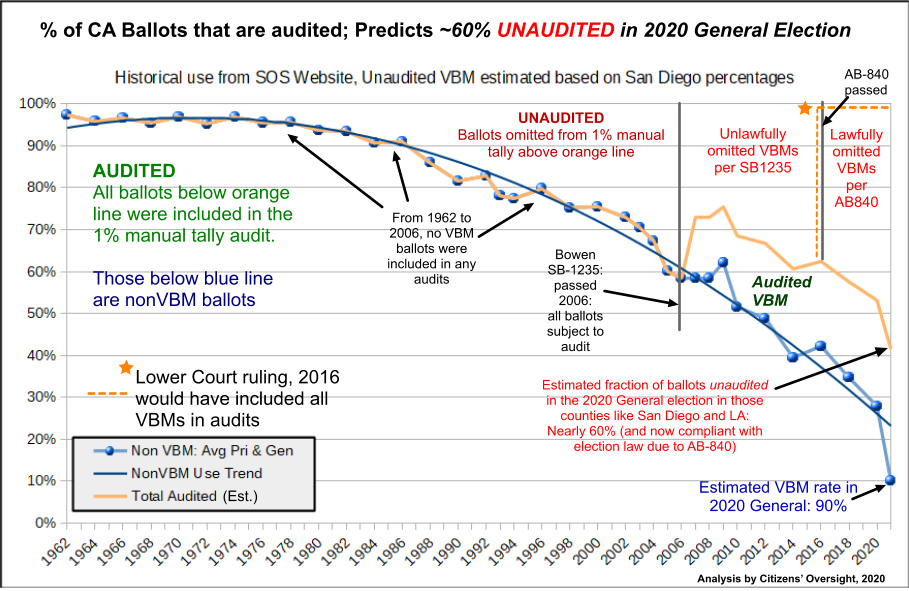
I made the following chart in 2020. The vertical axis represents the total percent of ballots that are included in the audit. We want the solid orange line be at the top, at nearly 100%. Instead, because mail ballots were unaudited, the fraction of ballots included in the audit dropped to about 60% in 2006. In 2016, ten years after Bowen's SB-1235 was passed, the situation was unchanged. The area over the orange curve are all the ballots not subject to any audit. About 40% were still excluded.
This is even worse today. (The dashed orange line in the upper right corner is where our ruling should have moved the audit coverage, but AB-840 allowed continued reduction of coverage.) By 2020 in San Diego, coverage dropped to about 60% UNAUDITED (est.).
Many ballots are returned during the final days before election day. Others are delivered on election day through drop boxes, vote centers, and the Postal Service. Additional ballots continue arriving during the canvass period if they were timely mailed.
As those numbers increased, the portion of the election falling outside the audit pool also increased.
An Additional Audit Avoidance Approach
What we are looking at here is avoidance of the audit. If large chucks of the ballot inventory is not subject to checking by the audit process, and particularly if those chucks can be easily targeted, then malicious actors can modify the computer results so they do not match the paper record, and it will never be detected. Even though we can be very happy that we have paper ballots that can be audited, these records do no good if we never use them to check on the accuracy of the computer result.
Receiving Inspection Diversion
I need to mention one more method for diverting ballots so they are not included in the semi-final canvass, which is supposed to be subjected to the audit. This method was used by San Diego as documented in my 2008 report on the processing, where I documented that perhaps 9,000 ballots were diverted by receiving inspection. We admit that some ballots may be torn or damaged so it can be predicted that scanners won't handle them well. There are two ways to handle this:
- Eager Diversion, where ballots are inspected and routing for remaking as they are received from polling places or extracted from the mail envelope. This method would be best if the scanners are primitive and failures are likely, and if electronic adjudication is not available or not strong.
- Lazy Diversion, where ballots are not removed in advance (unless there is obvious damage) and proceed with scanning. if there is a problem with scanning, pull out the problematic ballot and divert it for remaking. This approach may rely more heavily on post-scanning electronic adjudication.
In eager diversion, there may be more likely to divert rather than lazy diversion. But in either case, the problem is that the diverted ballots are likely NOT INCLUDED IN THE AUDIT. This is just the opposite of what should be the case, because these "hard ones" are exactly what we want to check.
The Breakthrough
Last year I discussed the issue with Shawn Brom, then the Deputy Registrar of Voters and who is now the Registrar, hopefully on a permanent basis.
His position was that the county was complying with the law by auditing only the semi-final canvass available shortly after election day.
My question was straightforward: Even though election offices can now legally omit many mail ballots from the audit, where should the audit boundary be drawn? Do they actively try to complete processing as many mail ballots as possible received right at the end, or the opposite, just to make the auditing process less of a hassle?
For the 2025 election on Prop 50 to allow redistricting, San Diego included in the scope of the audit:
- all early in-person ballots cast at voting centers*
- all in-person election day cast at voting centers*, and
- all fully processed mail ballots as of the morning of election day*.
But
- all mail ballots delivered by the postal service on election day (and after),
- all ballots from drop boxes collected on election day, and
- all mail ballots dropped off at voting centers on election day
- *All ballots diverted from the semi-final canvass for remaking or just to remove "hard" ballots (from flows above)
were omitted.
Is it okay to not include mail ballots received and processed ON election day? They think so.
In this most recent election, that was a large chunk, because voters were holding off as much as possible due to last minute changes in the governor contest lineup.
At the time of the initial random draw in the June 2, 2026 primary election, approximately 380,000 ballots had not yet been processed.
The county selected 23 vote-by-mail audit batches from the ballots that had already been completed, accounting for about 23 * 100 * 200 = 460,000 ballots, as there are typically 200 ballots per batch, and 1% are selected.
A Partial Yet Important Step Forward
This year, San Diego County took a different approach.
The Registrar scheduled a second public random draw to select additional audit batches from ballots processed after the initial draw.
That decision expanded audit coverage to a large population of ballots that previously would have been excluded entirely.
This is a breakthrough, even if only partial. We must acknowledge when election officials do the right thing, even if they do it kicking and screaming for the past 10 years. Michael Vu did not help election integrity. Not until Shawn Brom took them helm could we sense a new cooperative attitude. Thank you.
It demonstrates that expanding the audit pool is practical. It demonstrates that counties can adjust their procedures to include additional ballots. It demonstrates that audit coverage does not have to be frozen based solely on the earliest available canvass numbers.
The second random draw did not include every ballot that I believe should be represented in the audit. 12 additional batches were drawn, but another 5 batches should also be included in the audit. Perhaps we can adjust the date of the second draw or have a third draw. Or, officially start the 1% manual tally on Thursday after the election but hold the first random draw on the following Monday and a clean-up second draw a week later.
The larger statewide issue also remains, as this ridiculous limited audit is not confined to San Diego.
Summary (based on website results on June 16, 2026)
- Total ballots cast in the June 2, 2026 primary: 848,112
- Total Mail Ballots: 790,823
- Not included in the audit: 380,000 (from San Diego website as of June 4 random draw)
- Batches drawn in first round: 23.
- Approx. Ballots included in audit based on first round batch count: 23 * 200 * 100 = up to 460,000
- Approx. Ballots not included, 790,823 - 460,000 + 2,000 = up to 332,823
- Batches drawn in second round: 12
- Ballots included in audit based on second round batch count 12 * 200 * 100 = up to 240,000
- Remaining ballots after second round: about 100,000 --> about 5 batches.
- Vote Center Ballots: 57,289
- All included in the audit except those diverted. More research required.
Next Steps
**Our mission is clear. **
All counted ballots should be equally subject to audit.
This movement by San Diego is an important win. Partial, but important. A foot in the door. Progress, but still incomplete. Half of the remaining is not enough.
We plan the following:
A. Contact all counties and assess the current practice
Citizens Oversight will soon contact election officials throughout California and request information about their recent 1% manual tally audits, including the number of vote-by-mail ballots included in the audit pool and the number excluded because they were processed after the initial random draw, and not technically in the "semi-final official canvass". Also, we will seek answers regarding diversion for remaking, and whether these are included in the audit.
Based on the procedure used by San Diego, we will encourage counties to conduct additional random draws when necessary to maximize audit coverage of timely ballots counted during the canvass. By collecting data, we will know which counties are the worst offenders of common sense, and which ones are already being prudent.
B. Contact the Secretary of State (again)
Citizens Oversight will also submit recommendations to the California Secretary of State requesting a statewide review of audit coverage practices and encouraging procedures that maximize representation of timely ballots counted during the canvass period.
C. Develop Model Legislation and Recruit Sponsors
Finally, we will develop model legislation to reverse the changes enacted by AB 840.
The goal is straightforward: when ballots are included in the official election results, they should also be eligible for inclusion in the audit process that verifies those results.
You can help.
If you live in California, contact your county Elections Official (see https://www.sos.ca.gov/elections/voting-resources/county-elections-offices) and ask whether all timely vote-by-mail ballots are represented in the audit selection process. If substantial numbers of ballots are excluded from the audit pool, ask the county to conduct additional random draws so those ballots also have an opportunity to be selected for audit. Also, contact the SOS Shirley Weber https://www.sos.ca.gov/contact-information and let her know you don't like the partial audits going on in California.
If you live elsewhere, the question is still one that can can be asked. Some areas don't do any audits, but we are making progress.
Please join our team by sending your info to signup@citizensoversight.org
FOR IMMEDIATE RELEASE
After 10-Year Campaign, San Diego County Expands Election Audit to Include 375,000 Vote-by-Mail Ballots Otherwise Excluded
Additional public random draw scheduled Monday at 10:00 a.m.; media/public invited to attend
SAN DIEGO, Calif. — On Monday, June 8, 2026, at 10:00 a.m., the San Diego County Registrar of Voters will conduct an additional public random draw to select batches of vote-by-mail ballots for the county's post-election manual tally audit. The additional draw will extend audit coverage to ballots that were processed later in the canvass and were not included in the original audit selection.
The action marks the culmination of a ten-year effort by Citizens Oversight and election transparency advocate Raymond Lutz to improve the representativeness of California's post-election auditing process.
In 2016, Citizens Oversight requested that San Diego County expand its audit to include additional batches covering later-processed vote-by-mail ballots. At the time, approximately 285,000 ballots were effectively excluded from the audit selection process because they fell outside the batches selected for the manual tally. After the request was denied, Citizens Oversight filed suit and ultimately prevailed in court.
Following that victory, election officials across California sponsored legislation through the California Association of Clerks and Election Officials (CACEO). The resulting legislation, AB 840, changed California law and removed the requirement that audits include later-processed vote-by-mail ballots. As a result, many counties, including San Diego County, continued conducting audits without extending the audit pool to cover those ballots.
For the current election cycle, approximately 375,000 ballots—representing roughly 1,875 ballot batches—would have remained outside the audit pool under the prior practice. Because California's manual tally audits examine approximately one percent of batches, the additional random draw is expected to add approximately 19 audit batches from this previously excluded population, increasing the number of vote-by-mail audit batches from approximately 23 to approximately 42. (actually, only another 12 batches were chosen, leaving another 140,000 ballots out of the audit (est.))
While only a sample of ballots is manually audited, expanding the audit pool is important because it ensures that later-processed vote-by-mail ballots are represented in the audit process rather than being excluded entirely.
Under the leadership of Registrar of Voters Shawn K. Brom, San Diego County has now agreed to conduct an additional random draw and audit additional batches, extending audit coverage to ballots that previously would not have been represented in the audit process.
"This is an important step toward a more complete and representative post-election audit," said Raymond Lutz, Executive Director of Citizens Oversight. "For years, hundreds of thousands of valid vote-by-mail ballots were effectively excluded from the audit selection process. In 2016, that number was approximately 285,000 ballots. This year, it would have been about 375,000 ballots. We appreciate the new attitude of this department as demonstrated by the willingness of the current Registrar's office to address this longstanding issue and improve public confidence in election auditing. We hope this will become a normal practice and spread to other CA counties that are still excluding ballots from the audit."
The additional draw expands the audit process to provide greater assurance that the audited ballots reflect the full population of ballots counted in the election, including ballots processed later during the canvass period.
MEDIA ADVISORY
Television cameras, photographers, and other media representatives are welcome to attend and record the proceedings. Raymond Lutz, Executive Director of Citizens Oversight, will be available for interviews before and after the random draw.
Contact:
Raymond Lutz
Executive Director
Citizens Oversight, Inc
771 Jamacha Road #148
El Cajon, CA 92019
(619) 820-5321
raylutz@citizensoversight.org
citizensoversight.org
REF: See documents related to the case in 2016 here: ElectionAuditLawsuit There, you will find all other steps we took over the past 10 years.
ATTACHMENTS